

One of the wonderful things about the Clackamas River is that you can have a completely different adventure depending on where you put in.
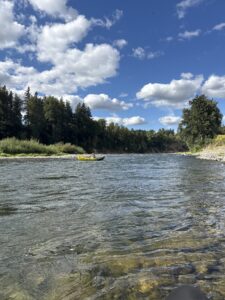
You can spend a peaceful morning paddling Estacada Lake, take the family on a short river trip, float for hours with friends, or paddle through some of the more exciting rapids of the lower Clackamas.
Here are some of our favorite ways to explore the river, beginning at Estacada Lake and working downstream toward Clackamette Park.
Estacada Lake: Paddle, Fish, Swim and Explore
Between two PGE dams, the Clackamas River becomes what is known as Estacada Lake. Near the lower end of the lake by Milo McIver State Park, the water becomes deeper and offers some great opportunities for fishing from a boat or the dock.
Estacada Lake is also beautiful to explore by kayak or SUP. As you paddle upstream, you’ll discover places to stop for a picnic or swim, waterfalls, beaches, basalt cliffs, small coves and ivy-covered rock walls.
As you continue farther upstream, you’ll begin to notice the current becoming stronger and may need to paddle harder. Remember that you’re sharing the lake with larger boats. Even though paddlers are more maneuverable, larger vessels may need more room to turn or stop, so stay aware, make yourself visible and give other boats plenty of space.
If you’re swimming or jumping from rocks, always inspect the area first. River and lake conditions change, and water depth, rocks and submerged debris can be different from one visit to the next.
McIver Upper Launch to Lower Launch: A Short River Adventure
If you’re looking for a shorter rafting or kayaking experience, try the section from the upper McIver boat launch down to the lower launch. Remember that right when you get in the waters, there are Level 1.5 rapids and you will need to be aware of the rocks and strong current in this first section. Always wear your PFD and have your dry bag connected to your vessel prior to getting in and going down the river.
This trip generally takes a little over an hour and includes fun rapids along with places where you may want to stop and swim or simply enjoy the riverbank.
Don’t let the short distance fool you—the Clackamas has a strong current. Wear a properly fitted PFD and keep looking downstream so you’re prepared for what’s coming next.
McIver to Barton Park: Mellow, Slower Waters
Continue beyond McIver toward Feldheimer and eventually Barton Park and the river begins to mellow, with stretches of slower water and smaller ripples.
This can be a beautiful section for kayaking and paddleboarding, but continue watching ahead. Trees, logs and branches can collect along shorelines and bends, and currents can sometimes pull a paddler toward them. Give wood and other obstacles plenty of room rather than waiting until you’re close to maneuver around them.
As you approach Barton Park, prepare early for your takeout. The boat ramp is on river right before the bridge.
Barton to Carver: The Classic Clackamas Float
Barton Park to Carver Park is probably the best-known recreational float on the lower Clackamas. Depending on river conditions and how often you stop, plan on approximately three to four hours.
You’ll experience small rapids, fun ripples, swimming areas and long stretches where you can simply relax and let the river carry you.
And maybe that’s one of the best parts.
Put the phone away for a while. Talk with the people floating beside you. Breathe. Look at the trees and cliffs. Listen to the water. Look up!
Watch for great blue herons, ducks, geese and ospreys. Ospreys are easy to recognize by their light-colored undersides and can often be spotted circling above the river before diving for fish. You may even get lucky and spot one of the bald eagles that frequent the Clackamas corridor.
When you see the large cliff on river right, you’ll know you’re getting closer to Carver. The Carver boat ramp is on river left before the bridge. There can be a strong current near the takeout, so prepare early and begin moving toward shore well before reaching the ramp.
Carver to Riverside: Peaceful and Beautiful
Carver Park to Riverside Park is another wonderful two-to-three-hour float and tends to offer a peaceful combination of ripples and flatter water.
Along the way are beaches where you can pull over, have a picnic or take a swim. You’ll pass basalt cliffs covered in flowers and ivy and follow the river as it twists around Sah-Hah-Lee Golf Course.
Keep watching the cliffs and shoreline for wildlife. Swifts and swallows dart in and out of their homes, and great blue herons love this section of river. On a recent birthday float with a friend experiencing the Clackamas for the first time, we spotted five great blue herons!
As you approach Riverside Park, watch for structures and rocks in the river and give them plenty of space. The boat ramp is on river right.
Riverside to Clackamette: Rapids, High Rocks and Adventure
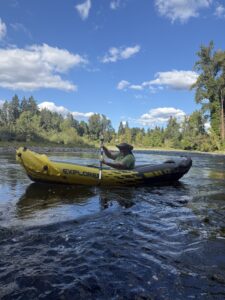
Riverside to Clackamette is one of my favorite sections because the scenery is beautiful and the water becomes more exciting.
You’ll find lush greenery, cliffs, little nooks along the shoreline and several areas of faster-moving water. This is a section where paddlers should have appropriate river skills, wear PFDs and pay close attention to current conditions and hazards. Aim your vessel into the V and take notice where the river pulls you as that is usually the best route.
One of the recognizable features along this stretch is the area known as Bunkhouse. You will want to float on the far left side entering this rapid and then as you go through the turbulance avoid rocks and keep paddling to enjoy the ride. Farther downstream you’ll pass beneath I-205, where logs and debris can sometimes collect around bridge structures. Give bridge pilings, downed trees and other obstructions plenty of room. This year in 2026 the flow seems to pull you in the right direction and still be aware.
Then you’ll reach High Rocks, a popular swimming and jumping area. Currents can be strong here, so use extra caution, especially if leaving your vessel or entering the water.
Farther downstream you’ll pass Cross Park in Gladstone. Some channels can become shallow depending on river levels, so keep looking ahead and choose your route carefully. If your boat does become grounded, stay calm and take your time getting free by wiggling your boat, pushing off of the rocks or sometimes you may have to get out and walk to deeper water.
Eventually the river carries you toward Clackamette Park, before Clackamette there is a rapid on the far right side where it is important to stay in the flow. Another possible takeout is Dahl Beach or float all the way to the confluence where the Clackamas meets the Willamette and you can continue to the Meldrum Bar Boat ramp on the right side of the river.
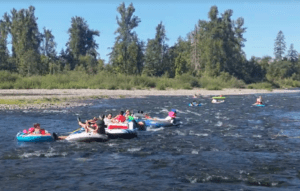
Cross Park to Dahl Beach: Fun, No-Hassle Float
For people wanting a shorter experience without coordinating vehicles, eNRG Kayaking offers a roughly 1½-hour float from Cross Park to Dahl Beach, including float tubes and transportation between their shop, put-in and takeout. To get on a tour, simply visit the enrgkayaking.com website and pick a time that is right for you and your friends.